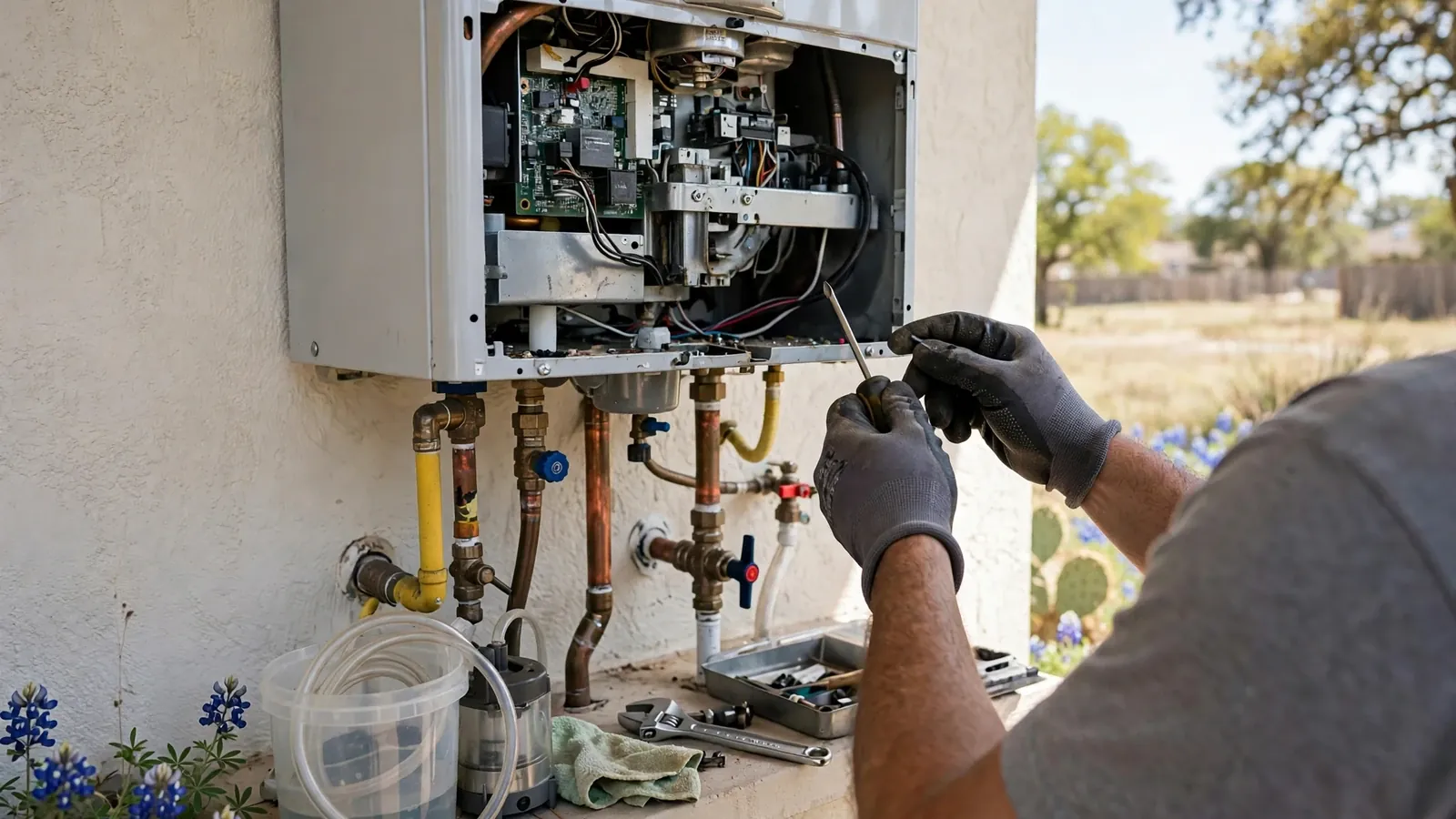
Why tankless sizing is not like sizing a tank
A tank holds a reserve. When a family showers back to back, the reserve runs down and recovers. A tankless unit heats water on demand, so its limit is how fast it can heat water flowing through, not how much it holds.
That makes peak demand the key number. If three fixtures run at once and the heater can only warm two of them to temperature, the third fixture runs cool.
A four-step sizing worksheet
- 01List what runs together
Write down the fixtures that could run at the same moment on a busy morning: showers, a kitchen faucet, a dishwasher, a washing machine.
- 02Add their flow rates
Check the label or box for gallons per minute. Showers often run around two gallons per minute, faucets less, and appliances vary.
- 03Find your temperature rise
Subtract the incoming water temperature from the temperature you want. Warm Florida groundwater means a smaller rise than in colder states.
- 04Match the unit
Compare your total flow and rise to the heater's rated output at that rise. Choose a unit that meets or beats your total, and ask the installer to confirm the rated output at your own temperature rise, not at a chart's best case.
Want a second set of eyes on your sizing worksheet? Call and we will go through it.
Call (855) 575-2890Gas or electric: the supply decides the size
Gas tankless units reach higher flow rates for whole-house demand, which is why many larger homes choose them, but they need a gas line of the right size and a vent that suits the model. Many older gas lines are sized for a small tank and need an upgrade.
Electric tankless units draw a heavy load. A whole-house model can need several large breakers and thick wire, and your panel may not have room. Smaller point-of-use units serve a single sink or shower with far less demand.
Check the panel before you pick a model
Ask an electrician or your plumber to read the main breaker rating and count open slots. If the panel is full, the project cost grows, and a smaller unit or a gas model may be the better path.
Rough sizing by household
These are directions, not rules. Your real fixture list matters more than your head count.
| Household pattern | Likely peak demand | Unit direction |
|---|---|---|
| One or two people, one bath | One shower plus a faucet | Smaller whole-house or large point-of-use |
| Family of four, two baths | Two showers or one shower and an appliance | Mid-size whole-house unit |
| Large family or many baths | Three or more fixtures at once | High-output gas, or two units |
If you cannot decide between sizes, ask for the manufacturer's flow-versus-rise chart for each model.
Tavares local note: water source and scale
Tavares Utilities pumps groundwater from the Floridan Aquifer, so incoming water in a Tavares home is warmer than the supply in colder climates. That lowers the temperature rise your heater must cover, which can allow a smaller unit than a northern chart suggests. Use your own measured tap temperature when you run the worksheet.
The City's published water quality report lists no hardness figure. Scale builds up on the heat exchanger of any tankless unit, so test your water with a home kit or ask the utility. If the water is hard, ask the installer about a scale filter and a flush schedule. Our tankless water heater work includes that discussion, and the same sizing talk applies to any water heater installation.
Common sizing mistakes
The first mistake is sizing by the number of bathrooms alone. Two bathrooms with one shower each in use at once is a very different load than two bathrooms where one person showers. Count fixtures running together, not rooms. A household that staggers showers can use a smaller unit than one where everyone leaves at the same hour.
The second mistake is ignoring the supply. A big unit on an undersized gas line will not reach its rated output.
The third is forgetting long pipe runs and low-flow fixtures, which can make the first water arrive slowly even with the right heater. A long run of cold pipe between the heater and a far bathroom means a wait no matter how large the unit is. Some homes add a small recirculation pump to shorten it, and that pump needs its own outlet and a return line.
DIY limits and when to call
You can do the worksheet yourself with a notepad, a bucket and a stopwatch to time a faucet. A kitchen thermometer gives you the cold-water temperature. That is enough to bring a solid list to a plumber. Add the fuel type and a photo of the gas meter or electrical panel, and the installer can give you a firm answer.
Installation is different. Gas piping, venting, condensate drains and large electrical circuits are not beginner work, and mistakes here can cause carbon monoxide or fire. If you are weighing a conversion, talk to a licensed plumber in Leesburg, Mount Dora or Tavares. Permit rules vary, so ask the City of Tavares Building Division.
Frequently asked questions
It depends on what runs at once. Two showers at about two gallons per minute each plus a faucet puts peak demand near five to six. List your own fixtures and time them. A plumber can then match that number to a unit's rated output.
Yes, in your favor. Warmer incoming water means the heater has less temperature rise to cover, so the same unit delivers more usable flow. Measure your own cold tap with a thermometer rather than relying on a national average.
Not always. Tankless units burn gas faster than tank models, so the pipe size and meter capacity may need to increase. Your plumber can check the line length and sizing. If it is too small, the upgrade becomes a real part of the project cost.
Only if the panel has the capacity and open slots. Whole-house electric units draw a heavy load. Have the main breaker rating and free slots checked first. A full panel may push you toward gas or a smaller point-of-use unit.
It can. Minerals build up as scale on the heat exchanger and reduce flow and efficiency. Tavares' water quality report does not list hardness, so test your tap. A flush with descaling solution each year, or a scale filter, helps protect the unit.
Two smaller units can make sense for a large house with far-apart bathrooms, because the hot water travels a shorter distance. One large unit costs less to run in many homes. A plumber can compare layouts and show you which option fits your plan.
Same-day appointments when available, and a clear price before work starts.
Call (855) 575-2890Sources and standards
Where this page cites a local fact, it comes from a public City of Tavares page, another city's own web page or a published water quality report. Where a figure is not published, the page says so instead of guessing.
Plumbing work in Florida is governed by the Florida Building Code, Plumbing, which is the standard inspectors apply, and permit rules vary by city. The contact page explains how to reach us, and any plumber's license can be checked with the Verify a License tool at MyFloridaLicense.com.