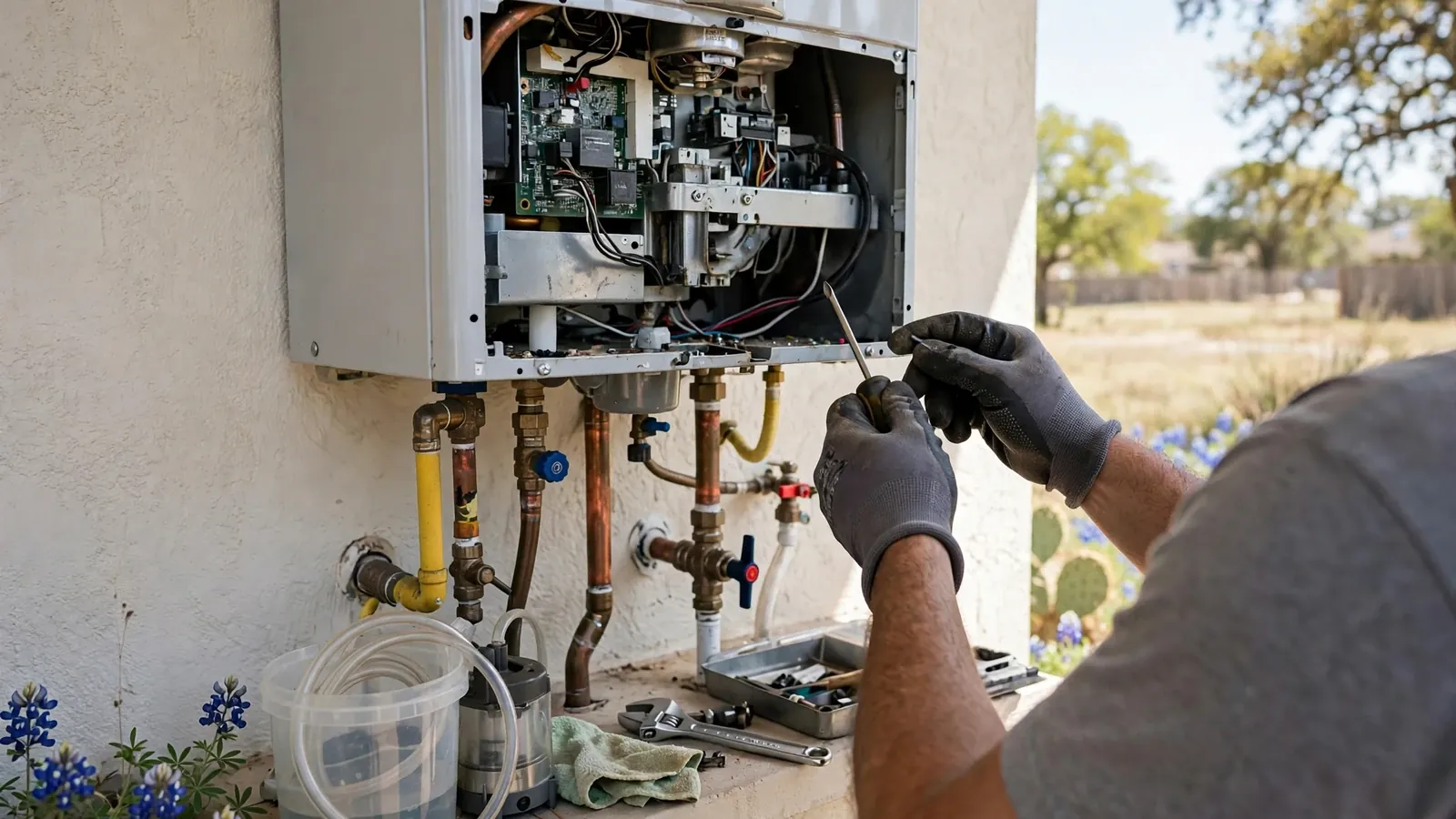
What tankless does well, and where it falls short
A tankless unit stops the standby loss that a tank suffers while it holds hot water all day. It also takes less wall space, and the heat exchanger can last longer than a steel tank with fewer parts to rust. For a home with steady daily hot water use and a long vacation schedule, these benefits are real.
The limits are equally real. A unit has a maximum flow at a given temperature rise, so running two showers and a dishwasher at once may exceed it. It costs more to buy and install than a tank, it needs scale management, and a power outage stops an electric or gas unit with an electronic control. The hot water also takes a few seconds to arrive, and that wait is a property of the pipe run, not of the heater.
Sizing: flow rate and temperature rise
Sizing is the single most important decision. The unit must heat the water you use at the same time, and the number on the box is only valid for a given temperature rise.
Count the flow
Add up the gallons per minute of every fixture that could run together. A shower often runs around 2 gallons per minute, a kitchen faucet 1 to 2, and a washing machine a few. Two showers and a sink can reach 5 or 6 gallons per minute.
Know the rise
Temperature rise is the difference between the water coming in and the temperature you want out. Groundwater in Florida enters warmer than in colder states, so the needed rise is smaller, though winter water is cooler than summer water. The maker's chart shows the flow a unit delivers at that rise, and we use the colder-month number so the unit does not struggle in January.
Weighing tankless or chasing an error code? Call and describe the unit.
Call (855) 575-2890Gas or electric tankless: what each demands
| Point | Gas tankless | Electric tankless |
|---|---|---|
| Capacity | Higher flow at the same rise | Lower flow for whole-home use, great for a single bathroom |
| Installation work | Larger gas line, new vent, condensate drain on condensing models | Heavy electrical service, several large breakers |
| Operating cost | Depends on the local gas price and unit efficiency | Depends on the electric rate, and usually higher per gallon |
| Common faults | Ignition, flame sensor, vent blockage, scale | Elements, flow sensor, scale, thermal limits |
| Good fit | Whole-house demand with gas available | A small home, an addition or a point-of-use unit |
A house without a gas line is a different project. The cost of new gas piping or a panel upgrade can change the comparison.
Gas lines, venting and electrical upgrades
A tank heater runs on a modest gas line. A tankless burner draws far more gas at full fire, so the supply line often needs a larger size or a new run from the meter. Venting changes too, since tankless units use special stainless or plastic vent materials that differ from a tank flue. The right pipe size and vent type come from the maker's instructions and the Florida Building Code, Plumbing.
Electric tankless units pull heavy current, and the panel must have the space and capacity for it. We check this at the first visit, because discovering a panel limit on install day delays the job. Where a gas line or panel upgrade is part of the scope, we tell you who will do it.
Signs your tankless heater needs a flush, and what to do first
Scale builds up inside the heat exchanger and the flow sensor, so many tankless problems trace to buildup rather than to a failed part. The common symptoms are below.
- An error code for overheating, ignition or flow that returns after a reset
- Water that swings between hot and lukewarm during a single shower
- Weaker hot water flow while cold water pressure is normal
- A long wait for hot water that was not there before
- The unit is louder, with knocking or whistling as it fires
- A gas unit cycles on and off, or an electric unit trips its breaker
A flush does not cure a failed part, but it removes the most common cause of these symptoms. If the symptoms stay after a flush, the plumber tests the sensors and igniter or elements next.
How a tankless flush and descale is done
- 01Isolate the unit
Power or gas is shut off, the water valves are closed, and the unit is allowed to cool. The built-in service valves are opened to attach hoses.
- 02Circulate descaler
A pump moves a mild acid solution, usually food-grade vinegar or a maker-approved descaler, through the heat exchanger for a set time.
- 03Rinse and clean the filter
Fresh water flushes out the loosened scale. The inlet screen is removed, cleaned and replaced.
- 04Test the unit
Service valves are closed, power or gas is restored, and the plumber checks temperature, flow and error codes.
What we know about Tavares water, and what we do not
City of Tavares Utilities draws groundwater from the Floridan Aquifer, and its published water quality report does not list a hardness figure. That means scale risk for your unit cannot be predicted from the report. A home test kit is inexpensive, and Tavares Utilities can answer questions about its water.
If the test shows hard water, a flush schedule matters more, and a water softener or filter on the supply line may be worth a look. Our water softener and filtration page explains what each device does and does not do. Do not guess at the interval for a flush. Check the maker's manual and the test result.
What drives the cost of a tankless water heater
A tankless project can cost much more than a tank swap, and the spread depends on the house. The plumber looks at the site and explains the price before work starts.
Higher flow units and condensing models cost more to buy.
A larger gas line and a new vent route are often the largest add-ons.
An electric unit can need a panel upgrade and heavy wiring.
A softener or filter protects the heat exchanger but adds a line item.
A flush on an existing unit costs far less than a new install. Isolation valves make later flushes simpler.
Insurance does not pay for a planned upgrade to tankless. If a covered loss destroyed the old heater, your adjuster may allow a like-for-like replacement and let you pay the difference. Ask first and keep the paperwork.
A phone call starts the process, and the plumber gives the price before touching a pipe.
Is tankless right for your home?
A tankless heater is a strong choice for a home with steady use, a spot for venting and the capacity for gas or electric service. It is a weaker choice for a home with very heavy simultaneous demand, a panel that cannot take the load, or a tight budget. A standard tank, covered on our water heater replacement page, is a sound answer in plenty of homes.
We serve Eustis and the rest of the area around Lake County, and we explain the choice in plain terms. If a tankless unit is not the best fit, we say so.
Frequently asked questions
Add up the flow of the fixtures that could run at once, then compare it with the unit's rated flow at your temperature rise. Use the cooler-month figure so it keeps up all year. A plumber can run the numbers from a quick walk-through.
Common causes are scale in the heat exchanger, a dirty inlet filter, a flow rate too low for the unit to fire, or a failing sensor. A flush and filter cleaning often fixes it. If not, we test the sensors.
The maker's manual sets the schedule, and your water decides how often it is needed. Because Tavares publishes no hardness figure, a home test kit gives you the answer. Harder water means more frequent flushing.
Often yes. A tankless burner draws more gas at once than a tank burner, so the supply pipe may need upsizing. We check at the first visit and tell you if new gas piping is part of the scope.
Generally not. Gas units still need power for the control board, igniter and fan, so a battery backup or generator is needed to keep hot water going. Check your model's manual.
It can be, when daily hot water use is steady and the installation is simple. If a gas line or panel upgrade is needed, the added cost can stretch the payback. We lay out both costs so you can judge.
Yes, flushing, descaling and diagnosing error codes are common requests. Tell us the make and model and any code on the display, and we will bring the right parts and descaling equipment.
Right size, clean heat exchanger, steady hot water. Call to start.
Call (855) 575-2890Sources and standards
Where this page cites a local fact, it comes from a public City of Tavares page, another city's own web page or a published water quality report. Where a figure is not published, the page says so instead of guessing.
Plumbing work in Florida is governed by the Florida Building Code, Plumbing, which is the standard inspectors apply, and permit rules vary by city. The contact page explains how to reach us, and any plumber's license can be checked with the Verify a License tool at MyFloridaLicense.com.