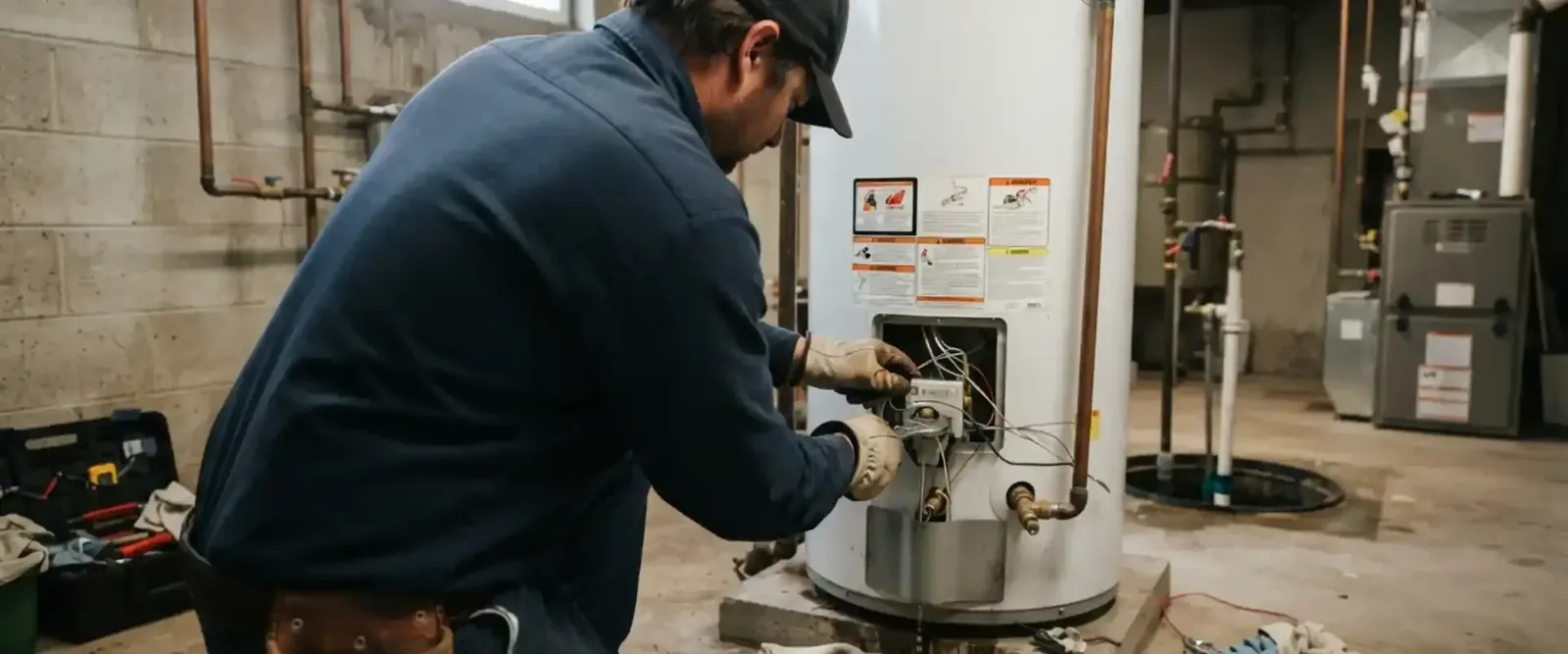
Leaking right now: shut it down in this order
A leaking heater needs three things stopped, in this sequence. The steps are quick and need no tools beyond what is in the house.
Find the shutoff valve on the pipe that enters the top of the tank, usually with a lever or round handle. Turn it until it stops. If it will not move, close the main water valve for the house.
For an electric heater, switch off its double breaker in the panel. For gas, turn the control dial to off or pilot. Never reach into water near a live electric unit.
Towels, a wet vacuum and a bucket under the drain pipe limit the spread. In a garage, push belongings away from the tank base.
Take pictures of the tank, its data label, the puddle and any wet drywall before you clean up. Insurance adjusters ask for them.
Leave the tank full if you can. Draining it right away makes it harder to see where the leak started.
Where the water is coming from
A wet floor around a water heater has three common sources, and only one of them means the tank is finished. A plumber finds the source by drying the area, then watching where the first drop forms.
Leaks from the tank body
Water seeping from the bottom seam or through the jacket means the steel tank has rusted through. No patch lasts on a pressurized tank. This is the case where replacement is the honest answer, and our water heater replacement page explains the choices.
Leaks at fittings and valves
Drips at the cold inlet, the hot outlet, the drain valve or a flexible connector are usually repairable. A new connector, a tightened union or a replacement drain valve can stop the water for the cost of a part and some labor.
Leaks from the relief valve or discharge pipe
The temperature and pressure relief valve opens on purpose when pressure or heat climbs too high. A steady drip often means pressure from the city line is spiking because thermal expansion has nowhere to go, and an expansion tank or a failed valve is to blame. We test pressure with a gauge before deciding.
Water at the base of the heater? Shut the cold valve and call us now.
Call (855) 575-2890No hot water: quick checks before the repair
Many no-hot-water calls start with something small. These checks take a few minutes and give the plumber useful information.
- Electric heater: look for a tripped breaker, and press the red reset button on the upper thermostat panel only after cutting power
- Gas heater: check whether the pilot is lit or the control shows an error light, and note any flashing code
- Hot water runs out fast: a failed lower element or a heavy sediment layer is common
- Water is lukewarm: a faulty thermostat, a half-failed element or a mixing valve problem may be the cause
- Hot water smells like rotten eggs: look at the anode rod and sediment, not at the cold water
- Water is hot at one faucet only: the heater is working and the issue is that fixture
Tell the dispatcher what you found. Electric, gas and heat pump hybrid heaters fail in different ways, and knowing which you have lets the plumber bring the right parts.
Sediment, the anode rod and the water Tavares uses
City of Tavares Utilities draws groundwater from the Floridan Aquifer through six wells, and the City's published water quality report does not list a hardness figure. That means scale on elements and tank bottoms is hard to predict without testing your tap, which a home kit can do cheaply. A heater with a thick sediment layer rumbles when it heats and loses capacity, and flushing the tank sometimes brings it back.
The anode rod is a replaceable metal rod that corrodes first so the steel tank does not. Once it is used up, the tank wall takes the damage. A hot-water-only rotten-egg smell often traces to a reaction at that rod, and swapping it for a different type can help. If the rod is already a thin wire, the tank may be near the end of its life and we will say so.
Gas, electric and hybrid heaters
Each type fails in its own way, so the first question on the call is which one you own.
Electric tanks
Failures here are usually a heating element, a thermostat or a high-limit switch. We test each with a meter, because replacing the wrong part wastes money. A burned element also shows up as a tripping breaker.
Gas tanks
Common faults are a worn thermocouple, a dirty burner, a failed gas control valve or a blocked vent. Gas work calls for caution, and we shut the unit down if we see signs of poor venting or backdrafting.
Hybrid heat pump heaters
These have a compressor and fan on top plus backup elements. If you hear loud fan noise, see an error code, or the unit only heats with its elements, the cause could be a clogged air filter, a drain line or a sealed-system fault. Some repairs go to the maker's service line.
Repair or replace: how we decide
| Fault | Usual answer | Why |
|---|---|---|
| Rusted tank, water at the seam | Replace | A steel tank cannot be patched under pressure |
| Bad element or thermostat on a young tank | Repair | A part fixes it and the rest of the tank is sound |
| Dripping drain valve or connector | Repair | Cheap parts, quick fix |
| Relief valve weeping, tank otherwise fine | Repair and test pressure | Valve or expansion tank may be the real fault |
| Tank is old, rumbling, with several faults | Usually replace | Repairs add up and the next failure is close |
| Pilot or burner trouble on a gas tank | Repair | Thermocouple or gas valve work is routine |
Tank life varies a lot with water quality, use and maintenance. The age on the data label helps, but the condition of the tank decides.
Heaters in garages and attics
Most Tavares-area homes sit on a concrete slab, which pushes water heaters into the garage, a closet or the attic. A garage unit leaks onto concrete and is usually found fast. An attic unit can drip for days into the ceiling below before a stain appears, so a drain pan with a pipe to the outside is worth checking.
If a heater has been leaking into a ceiling, tell the dispatcher so we plan for the access and the wet insulation. Where the origin of a wall or ceiling stain is unclear, a leak detection visit can tell whether the water came from the heater or from a supply line.
What a water heater repair costs
A repair price depends on what failed and how easy it is to reach. The plumber explains the price before starting, so you can compare it with the cost of a new unit.
An element, thermostat, relief valve or connector costs far less than a gas control valve or a heat pump component.
Electric, gas and hybrid units need different parts and test equipment.
A garage heater is quick to reach. An attic unit up a narrow pull-down ladder takes more time.
A repair to a worn tank may not be worth doing if another failure is near.
Nights and weekends can change the dispatch cost, and we say so before work starts.
Homeowners insurance may cover water damage from a sudden tank rupture, but wear, rust and a slow leak are often excluded. The failed heater itself is rarely covered. Photograph the unit and the damage, then ask your carrier before you file.
The fastest way to a real number is a call, because the price is explained before any work begins.
Tonight, or tomorrow morning
Not every heater problem needs a midnight visit. A tank that is leaking, a unit that smells of gas or a tripped breaker that will not hold is urgent. No hot water with no leak can often wait until the first same-day appointment when available, and the dispatcher helps you decide.
We repair heaters across Leesburg, Eustis and Mount Dora, and we follow the Florida Building Code, Plumbing for any work that touches the tank connections. If a permit is required, ask the City of Tavares Building Division, since permit rules vary.
Frequently asked questions
Yes. The line is staffed 24/7, including holidays. Close the cold water valve above the tank if it is leaking, tell the dispatcher what you see, and a licensed plumber is sent as quickly as the day allows.
It could be the drain valve, a loose connection, or the tank itself. If the water comes from the seam of the tank or the jacket, the steel has rusted through and replacement is needed. A drain valve drip is a simple repair.
Only if the leak is at a fitting or valve. A leak through the tank wall cannot be patched in any lasting way, because the tank is under pressure. We tell you which one it is after drying and inspecting the unit.
A burned element or a faulty thermostat can leave an electric unit running without heating. On gas models, a dirty burner or a failing gas valve may be at fault. Mixing valves can also cause it, so we test before replacing anything.
Often yes, especially if it rumbles or runs out of hot water quickly. Sediment settles at the bottom and insulates the water from the burner or element. A flush does not help a tank that is already leaking.
If the smell appears only with hot water, the heater is the likely cause, since the anode rod can feed bacteria that produce hydrogen sulfide. A rod change or a tank flush may fix it. If cold water smells too, the issue is in the supply.
Permit rules vary by job and by city, and the City of Tavares public pages do not state the water heater rule. Ask the City of Tavares Building Division at 201 E. Main Street. We can describe the work so you know what to ask.
No hot water at 6 a.m. or 11 p.m., the line is open and a plumber can be sent.
Call (855) 575-2890Sources and standards
Where this page cites a local fact, it comes from a public City of Tavares page, another city's own web page or a published water quality report. Where a figure is not published, the page says so instead of guessing.
Plumbing work in Florida is governed by the Florida Building Code, Plumbing, which is the standard inspectors apply, and permit rules vary by city. The contact page explains how to reach us, and any plumber's license can be checked with the Verify a License tool at MyFloridaLicense.com.