A line that keeps backing up cannot wait
A cable punches a hole through a clog and leaves the rest of the pipe alone. That is fine for one-time blockages. When the same drain slows again within a month or two, the pipe wall is carrying a coating of grease, scale or root fibers, and each pass with a cable only reopens a narrow channel.
A quick way to judge your own situation: if a plunger or a cable fixed it last time and it is back, the cable did not clean the pipe. If water backs up at a second fixture, the blockage is downstream of both. Either answer is a reason to ask for a camera visit.
Waiting costs more than it seems. A partly blocked main line holds wastewater against every joint, which stresses old fittings, and a full stoppage can send sewage into the lowest tub or shower. If a toilet and a floor drain are both acting up, call right away.
Camera first, then the jet
- 01Look inside
A small camera on a flexible rod goes in through a cleanout. It shows the pipe material, the sag points and what is actually clogging the line.
- 02Pick the nozzle
Rooted lines get a cutting or rotating nozzle. Greasy lines get a wide spray that scours the wall. The choice depends on what the picture shows.
- 03Jet in passes
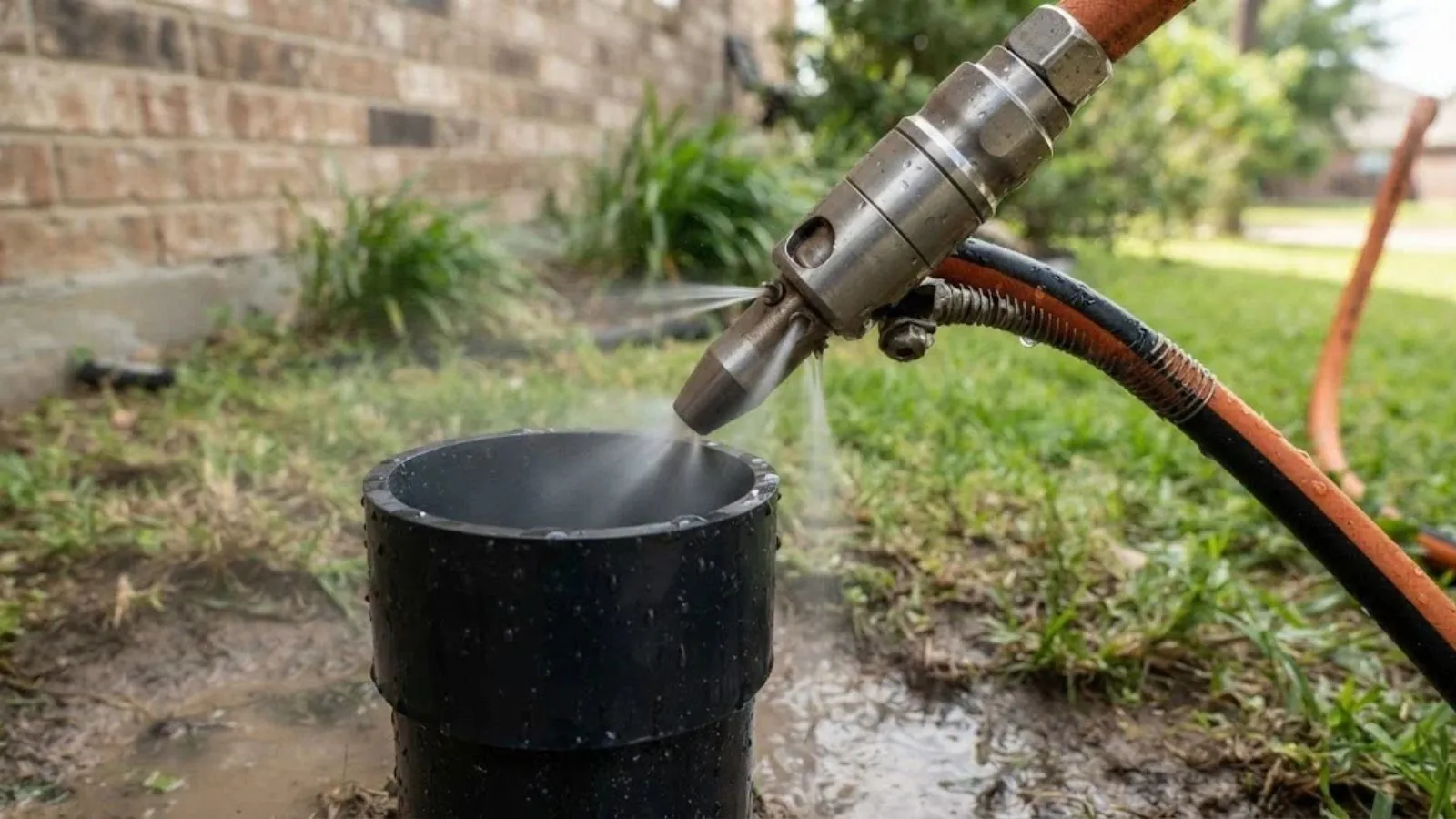
Water at high pressure runs through a hose, first to open a path and then to wash back toward the cleanout, pushing debris out of the line.
- 04Camera again
A second look confirms the wall is clean and shows whether cracks, offsets or low spots were hiding under the buildup.
Cable did not hold? Call and ask about a camera and jet visit.
Call (855) 575-2890What jetting removes: roots, grease and scale
The nozzle sends several water streams backward, which pulls the hose forward and clears the pipe wall as it goes. Pressure is set to suit the pipe, and old clay or thin cast iron gets a gentler setting than new PVC. Flow rate matters as much as pressure, since the volume of water is what carries the loosened debris down to the cleanout.
Tree roots
Roots enter at joints and cracks, then thicken into a mat that catches paper and waste. A rotating nozzle with a cutting head can shred that mat to the pipe wall. The roots will regrow if the opening stays, so a crack found on camera usually needs repair too.
Grease and soap film
Kitchen lines and laundry lines build a gray, waxy layer that narrows the bore a little each month. Jetting scours it off the wall. It works better than a cable here because a cable only cuts a path through the middle of the plug.
Scale and mineral crust
Cast iron drains grow a rough, flaky lining as they age. Jetting can knock loose a good part of it, though a pipe that is thin or heavily pitted may need replacement instead. The camera helps us tell which case you have.
What hydro jetting cannot fix
Jetting cleans pipe. It does not repair pipe. A collapsed section, a belly that holds standing water, a joint pulled apart by shifting soil, or a pipe crushed under a driveway will still be broken after a perfect cleaning. A camera cannot see through a full line either, so a stopped main may need a cable first to open a path.
We also decline to jet pipe that looks too fragile for the pressure. In that case we explain what the camera showed and talk through sewer line repair options instead.
Jetting compared with the other choices
| Problem | Does jetting help? | What may also be needed |
|---|---|---|
| Grease buildup in a kitchen or laundry line | Yes, it clears the wall | Habit changes, a grease-free sink |
| Roots in a lateral with open joints | Yes, for now | Repair or lining of the opening so roots do not return |
| Single soft clog in a sink | Not needed | A cable or hand tools are enough |
| Bellied pipe holding water | Only partly | Excavation or replacement to restore the slope |
| Collapsed or crushed pipe | No | Repair of the broken section |
| Tough scale in old cast iron | Often | Inspection to confirm the pipe is still sound |
The camera decides which row fits your line. If jetting will not help, we say so instead of selling it.
Lake lots, mature trees and older lines
Tavares sits on a narrow strip between Lake Eustis and Lake Dora, and many of its streets carry mature oaks and palms. Tree roots search out moisture, and a lateral on a wet lot gives them an easy target at any loose joint. Where a yard has big trees near the cleanout, jetting is often the cleaner option than repeated cabling.
The City of Tavares Wastewater Division describes a planned rehabilitation of the collection system in the CRA district, which covers the public side of the sewer. Your private lateral from the house to the street is a separate piece of pipe and ages on its own schedule, so a camera look is worth having if your house is older. Our sewer inspection visit shows the full length.
What affects the cost of hydro jetting
Jetting costs more than a cable run because it uses a truck-mounted or trailer-mounted jetter and often a camera. The plumber gives you a clear price before the work starts. Five things move it.
A short branch line is a small job. A long main out to the street, or a 6-inch line, takes more hose, more water and more time.
Light grease washes off quickly. A thick root mat or packed scale needs several passes and different nozzles.
A camera before and after adds time, and it is the way to know whether the line is clean and sound.
A good cleanout makes the job simple. When there is none, a toilet pull or roof vent may be the only way in.
Calls at night, on weekends and on holidays can change the dispatch cost, and we explain that before we begin.
Insurance rarely covers jetting that clears root or grease buildup, since it counts as maintenance. If a stoppage caused sewage to damage floors or walls, ask your carrier about water damage coverage and keep photos and the invoice.
Want your real number? Describe the job to a dispatcher and the price is explained before work starts.
After-hours and same-day jetting
A stopped main line does not follow a schedule, and neither does the dispatch line. At night we ask a few questions to decide whether a cable run can restore flow now and a camera and jet visit can follow the next day, or whether jetting is the right first step.
For lines that are slow but still draining, same-day appointments are offered when available. Our drain cleaning page covers the lighter methods, and sewer line cleaning explains main line work and backup safety. We also serve Leesburg, where many homes have lateral lines on larger lots with older trees.
Frequently asked questions
Yes. Our line is staffed 24 hours a day, every day. If a main line is stopped and sewage is rising, a licensed plumber is dispatched as fast as the day allows, and the first goal is to restore flow before planning a full jet and camera visit.
A cable cuts or hooks a clog and leaves the pipe wall coated. Jetting uses high-pressure water to wash the whole circumference of the pipe. Cabling is quicker for a simple blockage, while jetting suits repeat clogs, roots and grease.
It can if the pressure is wrong or the pipe is already weak. That is why we look with a camera first and set the pressure for the pipe material. We will not jet a line that appears too thin or cracked to take it.
No. It cuts roots out of the pipe, but if they entered through a crack or an open joint they will grow back. Repairing or lining the opening is the lasting fix, and the camera shows where it is.
Only when the camera shows buildup or the line clogs repeatedly. A healthy line does not need a schedule. Kitchens that handle heavy cooking and lines with known roots are the ones that sometimes benefit from a check every so often.
It helps a great deal. A cleanout gives the camera and hose a straight way in. If your house has none, tell us, because adding one can make future service simpler and cheaper.
Usually, but it depends on the system. Most of the flow stays in the pipe and leaves the house, yet sending a large burst of water into a tank can stir settled solids. Tell us if your home is on septic, and we will plan around it.
If the line stopped at midnight, we would rather hear from you then than at noon.
Call (855) 575-2890Sources and standards
Where this page cites a local fact, it comes from a public City of Tavares page, another city's own web page or a published water quality report. Where a figure is not published, the page says so instead of guessing.
Plumbing work in Florida is governed by the Florida Building Code, Plumbing, which is the standard inspectors apply, and permit rules vary by city. The contact page explains how to reach us, and any plumber's license can be checked with the Verify a License tool at MyFloridaLicense.com.