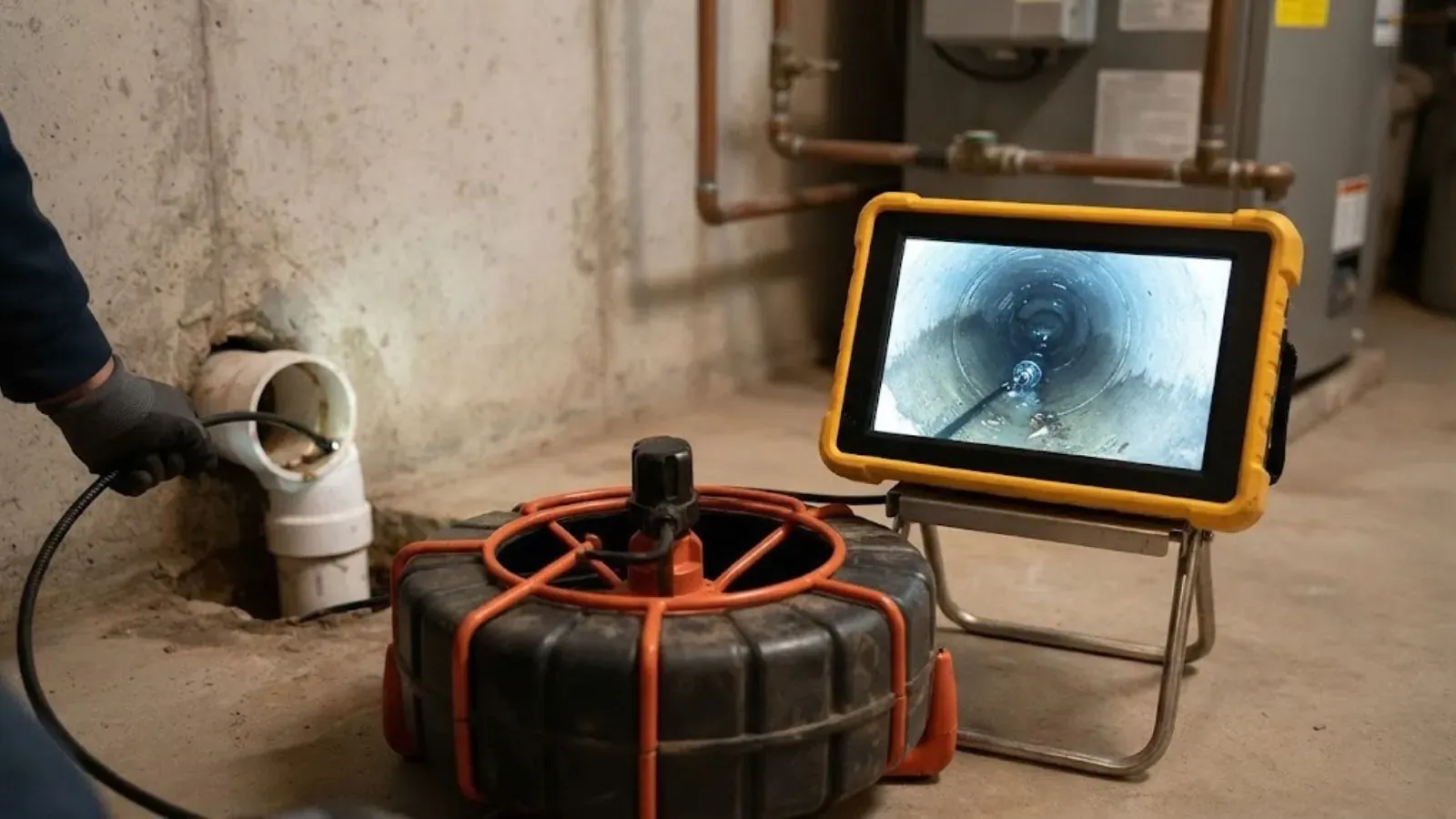
What the camera can show you
The camera head carries a light and a lens, and it moves from the cleanout toward the street or the tank. On the monitor we see the pipe wall, the joints and anything inside. A trained eye reads the images for cracks, offset joints, roots, scale, grease and low spots.
A locator at ground level picks up the signal from the camera head, which lets us mark the depth and path of the line. That information is useful for a repair plan, a landscaping project or a new addition that might sit over the pipe.
Where a camera stops: honest limits
A camera cannot see through a line that is full of water or waste, and it cannot judge the soil outside the pipe. Heavy buildup may need clearing before it can pass, and in that case we tell you the cleaning is a separate step. A camera also does not measure flow, so a pipe that looks sound can still have a slow section.
It also cannot see inside a collapsed section. If the camera stops where the pipe has fallen in, that stopping point tells us where to dig, and the rest of the line stays unseen until the repair is done.
Not sure what your sewer line looks like? Book a camera inspection.
Call (855) 575-2890Good reasons to book an inspection
You do not need a backup to benefit from a look inside the line. These are the most common reasons.
- You are buying or selling a house and want to know the condition of the line
- Drains clog again within weeks of being cleared
- You hear gurgling when the washer or a toilet drains
- A damp spot or sewer smell shows up in the yard
- Large trees stand near the line, or roots were found before
- A previous repair needs a check, or a contractor needs to see the line first
Buying or selling: what an inspection tells you
A general home inspection looks at the house, not the buried pipe. A sewer camera inspection fills that gap, and it is a common step before closing on a home with mature trees or older plumbing. For a seller, a clear result is something to show a buyer. For a buyer, a finding gives you facts to bring to the negotiation.
Schedule it early, since a repair estimate takes time to arrange. Ask what you will receive after the visit, such as footage or a written summary, so you can share it with your agent or inspector.
Reading the findings
| What the camera shows | What it usually means | Typical next step |
|---|---|---|
| Roots at a joint | A gap in the pipe lets roots in | Cut or jet the roots, then consider lining or replacing that section |
| Offset or separated joint | Pipe has shifted, often from soil movement | Spot repair or lining, depending on the gap |
| Belly or low spot | Pipe sags and holds water and waste | Monitor, clean regularly, or replace the section if backups repeat |
| Scale or flaking on cast iron | Pipe is corroding and narrowing | Clean it, then plan section replacement as it worsens |
| Grease or heavy buildup | Maintenance problem, not always damage | Hydro jet, then re-inspect |
| Cracked or broken pipe | Active leak into the soil or risk of collapse | Repair or replace the section, usually with excavation or lining |
Camera images need interpretation, and a second look after cleaning often shows more than the first pass.
How a camera inspection goes
- 01Find the access point
We use the cleanout, a pulled toilet or a vent if there is no cleanout. A missing cleanout is itself a finding worth fixing.
- 02Clear what blocks the view
If grease or debris blocks the lens, a cable or jet clears a path first, and we explain that before charging for it.
- 03Run the camera and locate
The camera moves toward the street or tank while the locator marks the path and depth at problem spots.
- 04Review it with you
We go over what was seen, which items need action, and which are only worth watching.
When to clean the line before the camera
If the line is heavily clogged, the picture will be poor and may miss the damage that caused the clog. In that case hydro-jetting scours grease and roots from the pipe wall, and the camera then follows to show the pipe underneath. A line that has simply been clogged and cleared once may not need a camera, while a line that clogs repeatedly does.
If sewage is already backing up into the house, that is a clearing job first. Our sewer line cleaning page covers what to do.
What affects the price of a sewer inspection
An inspection is priced by the work involved, and the number is explained before the camera goes in. Four things matter most.
A cleanout makes the job straightforward. Pulling a toilet to get in takes longer.
A short, clear line is quick. A long run with buildup takes more time.
Clearing grease or roots before the camera is extra work and is quoted separately.
Marking the path and depth for a repair or a project adds time.
Home insurance rarely pays for an inspection by itself. If a covered loss such as a sudden backup is involved, the carrier may want the camera report, so keep it with your claim papers.
A phone call starts the process, and the plumber gives the price before touching a pipe.
Sewer lines in older Tavares neighborhoods
The City of Tavares describes a planned collection-system rehabilitation in its CRA district, which includes older areas near downtown. Where older streets have mature trees close to the lines, roots are a main reason cameras find damage, so ask for a look if your lot fits that picture.
The same applies in nearby Eustis and Mount Dora, where historic districts have older plumbing. If a camera finds damage, the next step is covered in sewer line repair. Home sales with older plumbing are where we see the most value in a camera look.
Frequently asked questions
The time on site depends on access, the length of the run and how clear the line is. A heavily clogged line takes longer because it has to be cleared first. We give you a realistic window when you book.
A cleanout is the easiest entry point, but it is not required. We can often use a toilet, a vent or another access. If your home has no cleanout, installing one is worth discussing, since it helps with every future service.
It is a good idea, especially for older homes or lots with mature trees. A general home inspection does not look inside the buried line. A camera inspection shows cracks, roots and bellies, which can be costly to fix after closing.
It can show cracks, open joints and root intrusion that cause leaks, and sometimes soil or water entering the pipe. It cannot always confirm that a crack is actively leaking. Dye or pressure tests may be added for that.
That usually means a blockage, a collapse or a severe offset. We note where it stopped, clear the line if possible, and try again. If it stops at the same spot, that location is where the damage most likely is.
No. Cleaning removes buildup, and inspection shows the pipe's condition. They often go together, since a clean line gives a clearer picture. You can book either one separately.
See the pipe before you pay to fix it, and call to book your camera visit.
Call (855) 575-2890Sources and standards
Where this page cites a local fact, it comes from a public City of Tavares page, another city's own web page or a published water quality report. Where a figure is not published, the page says so instead of guessing.
Plumbing work in Florida is governed by the Florida Building Code, Plumbing, which is the standard inspectors apply, and permit rules vary by city. The contact page explains how to reach us, and any plumber's license can be checked with the Verify a License tool at MyFloridaLicense.com.