Signs the pipes in your house are done
One leak does not mean a whole house needs new pipe. A pattern of problems does.
- Pinhole leaks or green crust on copper lines in more than one place
- Brown or rusty water when the faucet has not been used for a while
- Weak flow at several fixtures, not just one
- Visible rust, flaking or bulging on exposed steel pipe
- Gray or tan plastic pipe in the attic or under sinks, which may be polybutylene
- Repeated repairs at fittings on the same run
- Stains on ceilings or baseboards with no clear source
- Metallic taste or odor at the tap
Water that is rust-colored only in the morning points to old steel pipe. Rust at one faucet only usually points to that faucet's own supply line.
Pipe age matters more than water quality
The City of Tavares water quality report for 2023 shows lead at 0.8 parts per billion and copper at 0.15 parts per million at the 90th percentile, with no exceedance of either limit. That tells you about the city's supply at sampled homes, not about the pipe inside yours. A house built decades ago can still have corroding pipe, because the failures depend on the pipe's age and material.
Galvanized steel, common in older homes, rusts from the inside and narrows over time. Polybutylene, installed in many US homes from the late 1970s into the mid 1990s, can crack at fittings without warning. Copper lasts a long time but develops pinholes where water chemistry or flow wears it. If you only need to know where a leak is hiding, leak detection comes before any decision to replace pipe.
Third pinhole this year? Call and ask whether a repipe makes sense.
Call (855) 575-2890PEX, copper and CPVC compared
| Material | Strengths | Trade-offs |
|---|---|---|
| PEX | Flexible, easier to route through walls, fewer joints, resists splitting | Must be kept out of direct sunlight and protected from some chemicals |
| Copper | Proven for decades, heat resistant, rigid and neat | Higher material cost, more labor, can pit in some water |
| CPVC | Lower material cost, no corrosion | Can become brittle with age and heat, needs support |
No material is perfect. The plumber compares them for your house and explains the reasons.
What a repipe involves
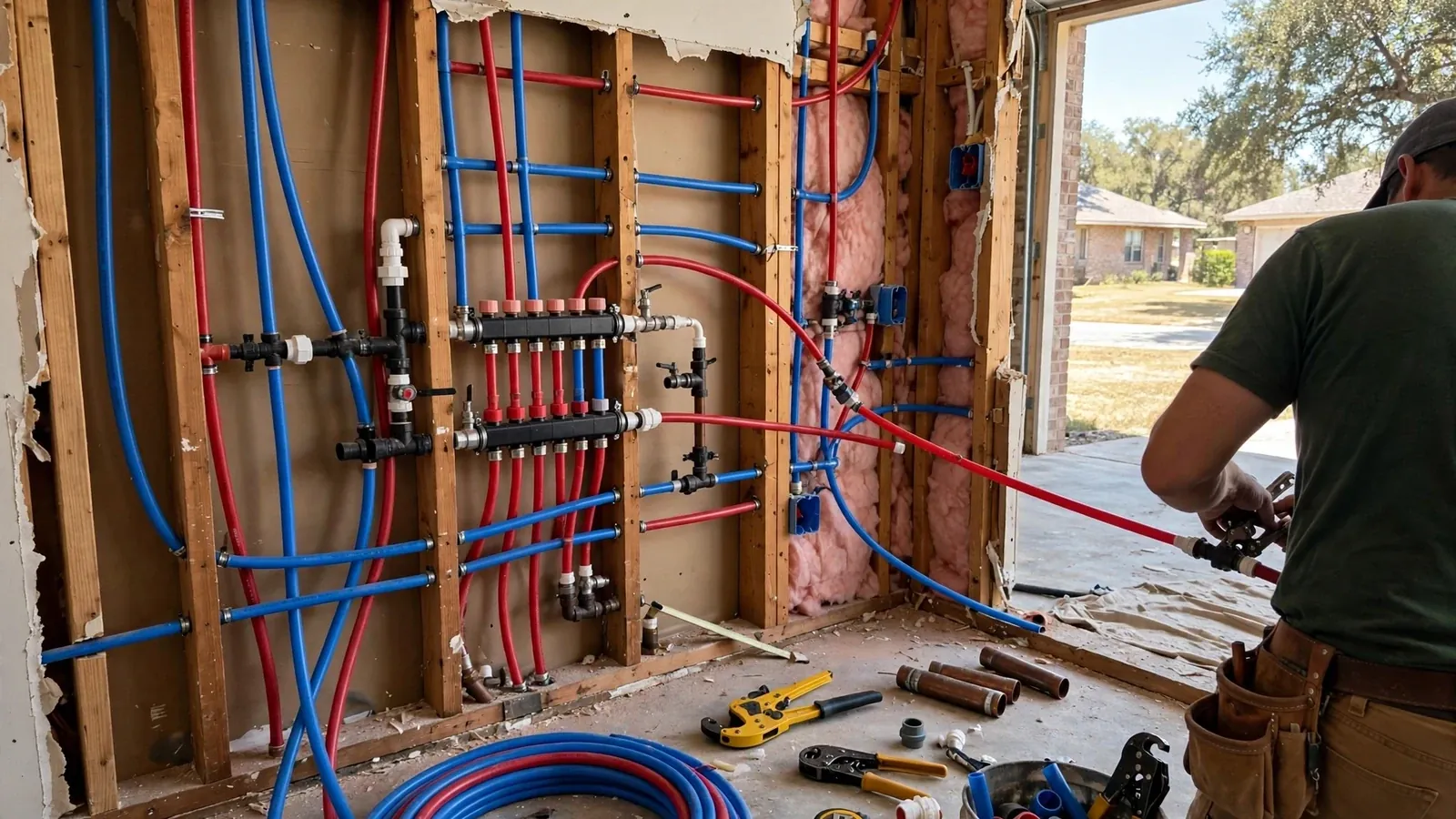
The plumber maps the existing lines, decides where the new ones will run, and cuts access holes in drywall at key points. In slab homes the lines run through the attic or walls, so ceilings are often opened rather than floors. New lines connect to a manifold or a trunk-and-branch layout, then each fixture is reconnected.
Before the walls are closed, the system is pressure tested with water on, and you are walked through the work. Drywall patches are small, but paint and texture matching is a separate trade that you may want to arrange yourself.
Whole house or partial repipe
A partial repipe replaces the worst run, such as the line to a bathroom group, and leaves sound pipe in place. It suits homes where the rest of the plumbing is newer or mixed. A full repipe suits homes where all pipe is the same age and material, since failures tend to follow each other.
The wrong choice is to patch a leak every few months. Each repair costs a visit, and each leak damages drywall or flooring. If you are weighing it, ask for the cost of both options so you can see where the line falls.
How to plan the job
- 01Survey
The plumber finds the pipe material, checks pressure and notes where walls or ceilings must be opened.
- 02Choose the scope
You decide between a partial and full repipe, and the material is selected with you.
- 03Stage the work
Ask how the water will be handled during the work so you know when it will be off and for how long.
- 04Test and close
The new system is pressure tested before any wall is patched, and you see the result.
What repiping costs
Repiping prices vary more than most plumbing jobs. These are the factors that move them.
More bathrooms and a longer pipe run mean more material and labor.
PEX, copper and CPVC differ in material and labor cost.
Open attics are quick. Finished walls, tile and tight spaces take longer.
Each sink, toilet, tub and appliance adds connections.
Drywall repair and paint are separate unless arranged ahead.
Insurance seldom pays to replace pipe just because it is old, but it may cover damage from a sudden leak. Ask your carrier what applies, and keep photos and invoices from earlier repairs.
Tell the dispatcher what you see and the plumber will explain the price on site before starting.
Repiping in older Tavares and nearby homes
Tavares has neighborhoods built across several decades, and the supply pipe in each reflects its era. Houses from the late 1970s into the mid 1990s are the ones most likely to have polybutylene, while older ones may carry galvanized steel behind plaster. Newer homes near State Road 19 more often have copper or PEX and rarely need repiping.
Historic homes in Eustis and Mount Dora bring their own issues, such as plaster walls that make access slower. If a single leak is all you have, our burst pipe repair covers it without a full repipe.
Frequently asked questions
Look in the attic, under sinks and near the water heater for gray, tan or dark plastic pipe, often with printed markings. Not every gray pipe is polybutylene, so have the plumber confirm. If you have it, planning a replacement is wise.
In most slab-on-grade Tavares homes, the supply runs through the attic or walls, so ceilings and wall sections are opened rather than the slab. The plumber tells you where openings will be before the job starts.
Neither wins everywhere. PEX is flexible, quick to install and resists splitting. Copper has a long track record and handles heat well. The right choice depends on your house, access and budget.
That depends on the size of the house and how the work is staged. Ask the plumber how the water will be turned off and back on, and whether it can be restored overnight.
Yes. A partial repipe replaces the worst run and leaves sound pipe in place. It makes sense when the rest of the plumbing is newer or already updated.
Often, if corroded steel is the cause. If the pressure problem comes from a failing regulator or the water service line, new interior pipe will not fix it, and the plumber will check those first.
Old pipes rarely fail once. Call and let us look at the whole system.
Call (855) 575-2890Sources and standards
Where this page cites a local fact, it comes from a public City of Tavares page, another city's own web page or a published water quality report. Where a figure is not published, the page says so instead of guessing.
Plumbing work in Florida is governed by the Florida Building Code, Plumbing, which is the standard inspectors apply, and permit rules vary by city. The contact page explains how to reach us, and any plumber's license can be checked with the Verify a License tool at MyFloridaLicense.com.